WhatsApp CRM vs Email CRM: Which Is Better for Sales in 2026?
WhatsApp CRM gets 98% open rates vs email's 20%. Compare response times, conversion rates, and pipeline fit — especially for Pakistan, India, and MENA sales teams.
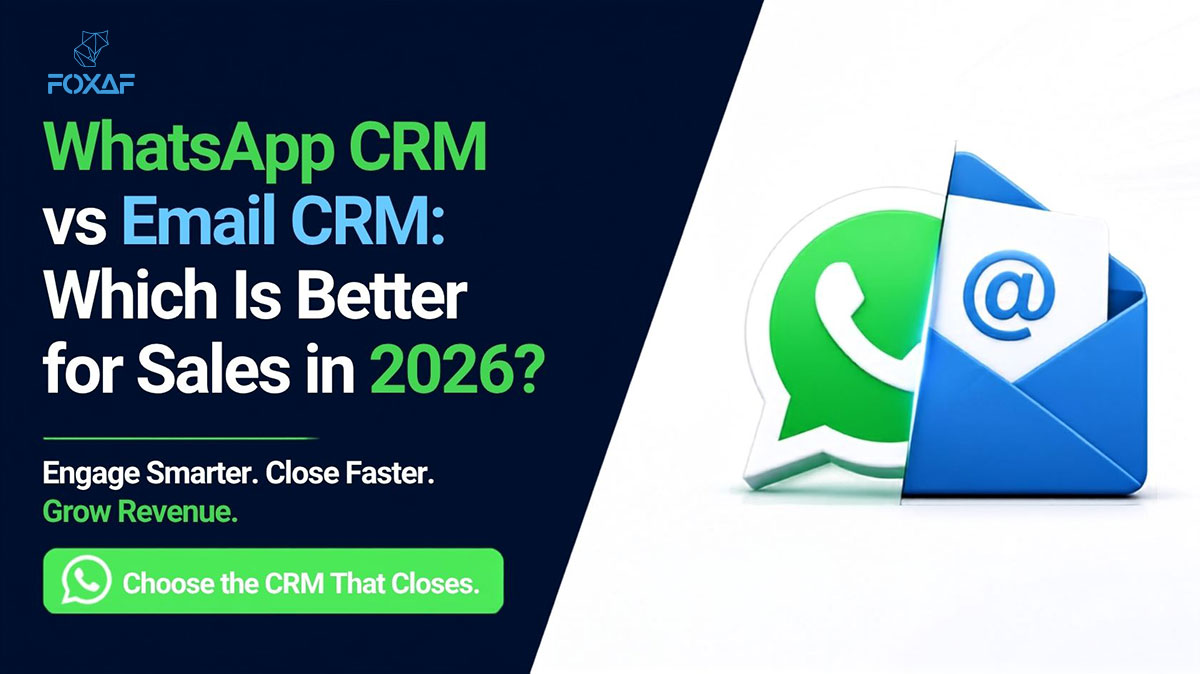
WhatsApp CRM is better than email CRM for sales in markets where customers live on messaging apps. WhatsApp messages hit 98% open rates and get replies in minutes. Emails average 20-25% open rates and replies take hours — if they come at all. For sales teams in Pakistan, India, the Middle East, and Latin America, a WhatsApp-first CRM closes more deals, faster, because it meets buyers where they already are.
That does not mean email is dead. It means email is no longer the primary sales channel in most of the world — and your CRM should reflect that.
Why are sales teams switching from email CRM to WhatsApp CRM?
The shift is simple: customers stopped checking email for buying decisions. In Pakistan, a buyer who messages you on WhatsApp at 2pm expects a reply by 2:05pm. If you send them an email instead, they may not see it until tomorrow — or ever.
Sales teams are switching because:
- Conversations are faster. WhatsApp is real-time. Email is asynchronous. In sales, speed-to-lead is one of the strongest predictors of conversion. Harvard Business Review research found that companies responding within five minutes are 21 times more likely to qualify a lead than those responding in 30 minutes.
- Customers prefer it. Over 2 billion people use WhatsApp monthly. In Pakistan, India, Brazil, and across the Gulf states, WhatsApp is the default communication app — not just for personal chat but for business inquiries, order confirmations, and support.
- Read receipts and delivery status are built in. You know exactly when a message was delivered and read. Email gives you open-rate estimates based on pixel tracking, which Apple's Mail Privacy Protection and other tools have made increasingly unreliable.
- The conversation history stays in one thread. No lost email chains, no "check your spam folder," no formatting issues across clients. One continuous chat.
Traditional CRMs like Salesforce, HubSpot, and Zoho were built around email as the core channel. WhatsApp was bolted on later, often through third-party integrations that break context. A WhatsApp CRM flips this — WhatsApp is the primary channel, and everything else (pipeline, automation, campaigns) is built around it.
What open rates does WhatsApp get vs email?
This is the stat that gets the most attention, and it holds up:
- WhatsApp messages: 98% open rate, based on industry benchmarks from multiple messaging platform providers. Most messages are read within 3 minutes of delivery.
- Email: 20-25% average open rate across industries, according to Mailchimp, Campaign Monitor, and similar platforms. And that figure has become less reliable since Apple introduced Mail Privacy Protection in iOS 15, which pre-loads email pixels and inflates apparent open rates.
But open rates only tell part of the story. What matters for sales is what happens after the open:
- WhatsApp response rate: 40-60% on business messages, based on data from WhatsApp Business API providers.
- Email response rate: 1-5% on cold outreach, 10-15% on warm sequences.
- WhatsApp average response time: Under 90 seconds for engaged leads.
- Email average response time: 2-24 hours, if a reply comes at all.
For a sales rep managing a pipeline of COD orders in Karachi or a real estate agent following up with leads in Dubai, the difference between a 90-second reply and a 12-hour reply is the difference between a closed deal and a lost one.
How do WhatsApp CRM and email CRM compare across key dimensions?
Here is a side-by-side comparison across the dimensions that matter most to sales teams — especially those operating in WhatsApp-dominant markets.
| Dimension | WhatsApp CRM | Email CRM |
|---|---|---|
| Open rate | ~98% | 20-25% (inflated by privacy pre-loads) |
| Average response time | Under 90 seconds | 2-24 hours |
| Response rate | 40-60% | 1-15% depending on warmth |
| Rich media in conversation | Images, videos, documents, location, catalogs — native | Attachments, often blocked or clipped |
| Two-way conversation | Real-time, in-thread | Asynchronous, threaded by subject line |
| COD/order confirmation | Automated via message + reply ("YES") | Requires separate form or phone call |
| Spam/deliverability risk | Low (opt-in required by Meta policy) | High (SPF/DKIM/DMARC, spam filters, promotions tab) |
| Pipeline integration | Native in WhatsApp CRMs like Foxaf | Native in most email CRMs |
| Broadcast campaigns | Template-based, approved by Meta, high open rate | Flexible formatting, lower open rate |
| Cost per conversation | WhatsApp API charges per conversation window (24h) | Free to send (but platform subscription fees apply) |
A few takeaways from this table:
Email CRM wins on formatting flexibility (HTML templates, long-form content), cost per message (no per-conversation charge), and deep pipeline/reporting features built over decades.
WhatsApp CRM wins on everything that matters at the point of sale: speed, engagement, read confirmation, and conversion. If your sales process depends on getting a fast reply — which it does for COD ecommerce, real estate inquiries, service bookings, and B2B follow-ups in emerging markets — WhatsApp is the stronger channel.
What are the real-world results for WhatsApp-first sales teams?
Let us look at the kinds of businesses where WhatsApp CRM makes the biggest difference.
COD ecommerce in Pakistan
A clothing brand shipping COD across Pakistan lives and dies by order confirmation. If a customer places an order but does not confirm when prompted, the return-to-origin (RTO) rate climbs above 30%. With WhatsApp CRM, the flow is: customer orders, CRM sends a confirmation message on WhatsApp, customer replies "YES," order moves to confirmed. This automated confirmation — which Foxaf handles natively — can reduce RTO rates by 20-40%. Email confirmation for COD orders in Pakistan has near-zero effectiveness because most customers simply do not check email for purchase-related messages.
Real estate and high-ticket sales in MENA
Real estate agents in Dubai, Riyadh, and Doha rely on WhatsApp for every buyer interaction. A lead that comes in through a property portal expects a WhatsApp reply, not an email. An email CRM forces the agent to work in two systems — the CRM for records and WhatsApp for the actual conversation. A WhatsApp CRM puts both in one place, with the conversation attached to the deal record.
Service businesses in India and Pakistan
Clinics, tuition centres, salons, and consultants in Lahore, Mumbai, and Karachi book appointments through WhatsApp. An AI-powered WhatsApp CRM can handle the booking conversation automatically — check availability, confirm the slot, send a reminder — without the business owner touching their phone.
Does email CRM still have a role?
Yes. Email is not going away, and for certain use cases it remains the right tool:
- B2B sales in Western markets where email is still the professional default.
- Long-form nurture sequences — educational content, newsletters, onboarding drips — where formatting and link tracking matter.
- Compliance-heavy industries (finance, healthcare in regulated markets) where email creates a formal audit trail.
- Large-scale cold outreach where the cost-per-message economics of email (effectively zero marginal cost) outweigh WhatsApp's per-conversation charges.
The mistake is not using email. The mistake is using email as your primary sales channel in a market where your customers respond on WhatsApp — and then wondering why your pipeline moves slowly.
Can you use both WhatsApp and email in one CRM?
You can, and many businesses should. The question is which channel is primary and which is supplementary.
An email-first CRM with WhatsApp bolted on (via Zapier, a third-party plugin, or a basic API integration) creates friction. The WhatsApp conversation lives in a sidebar or a separate tab. It is not tied to the deal pipeline. You cannot automate WhatsApp follow-ups the way you automate email sequences. You end up managing two workflows in a tool optimised for one.
A WhatsApp-first CRM that also supports email gives you the best of both. Foxaf, for example, is built around WhatsApp as the core channel — shared inbox, pipeline, automated follow-ups, broadcasts, AI responses — but you are not locked out of email when you need it. The point is that WhatsApp is the first-class channel, not an afterthought.
If you are not sure what a WhatsApp CRM actually is or how it differs from a regular CRM with a WhatsApp plugin, that guide covers the fundamentals.
How should you decide which type of CRM to use?
Ask yourself three questions:
- Where do your customers reply? If more than half your customer conversations happen on WhatsApp, you need a WhatsApp-first CRM. If most happen over email, an email CRM is fine.
- How fast does your sales cycle need to be? If you are selling COD products, booking appointments, or closing deals where response time is critical, WhatsApp wins. If your sales cycle is weeks-long with multiple stakeholders reviewing proposals, email may be more appropriate.
- What market are you in? In Pakistan, India, Brazil, Indonesia, the Gulf states, and most of Africa, WhatsApp is dominant. In the US, Canada, and parts of Western Europe, email still holds. Your CRM should match your market.
For most sales teams in Pakistan and similar markets, the answer is clear. Your CRM should speak WhatsApp natively. If you want to see how that works in practice, check out how to manage WhatsApp leads in a pipeline or explore Foxaf's WhatsApp CRM for Pakistan.
What does the future look like for WhatsApp CRM vs email CRM?
The trend is moving decisively toward messaging. Meta continues to invest heavily in WhatsApp Business features — catalogs, payments (live in India and Brazil), click-to-WhatsApp ads, and the Business API. Meanwhile, email open rates continue to decline as privacy features strip out tracking and younger buyers default to messaging for everything.
By 2027, industry analysts expect messaging-based CRMs to be the default for SMBs in Asia, MENA, Africa, and Latin America — the markets where most of the world's new businesses are being built.
The smart move is not to wait for the shift to complete. It is to get your pipeline on WhatsApp now, build your automations, train your team, and start capturing the leads that your email-only competitors are losing. Check Foxaf pricing to see what that costs in practice.
Frequently asked questions
Is WhatsApp CRM better than email CRM for sales?
For markets where WhatsApp is the dominant messaging app — Pakistan, India, MENA, Latin America — WhatsApp CRM outperforms email CRM on open rates (98% vs 20-25%), response times (under 90 seconds vs hours), and conversion rates. Email CRM is still strong for B2B in Western markets and long-form nurture sequences.
What is the open rate of WhatsApp vs email?
WhatsApp business messages achieve approximately 98% open rates, with most messages read within 3 minutes. Email averages 20-25% open rates across industries, and that figure is increasingly unreliable due to privacy features that inflate apparent opens.
Can I use WhatsApp and email in the same CRM?
Yes. A WhatsApp-first CRM like Foxaf supports WhatsApp as the primary channel while still allowing email when needed. The key difference from email-first CRMs is that WhatsApp is deeply integrated into the pipeline, automation, and AI — not treated as a plugin.
What is the response rate on WhatsApp vs email?
WhatsApp business messages see 40-60% response rates. Email cold outreach gets 1-5%, and warm email sequences get 10-15%. The gap is even wider in emerging markets where email is rarely used for purchase decisions.
Is WhatsApp CRM more expensive than email CRM?
WhatsApp CRM involves per-conversation charges from Meta's WhatsApp Business API (varying by country), plus the CRM subscription. Email CRM has no per-message cost but requires a platform subscription. For high-engagement sales where you need replies, WhatsApp's higher per-message cost is offset by dramatically better conversion rates.
How does WhatsApp CRM handle COD order confirmation?
A WhatsApp CRM sends an automated confirmation message after an order is placed. The customer replies to confirm, and the CRM updates the deal status automatically. This is especially critical in Pakistan where COD accounts for 70-80% of ecommerce orders and reduces return-to-origin rates by 20-40%.
Do I need WhatsApp Business API for a WhatsApp CRM?
Yes. A WhatsApp CRM connects through the official WhatsApp Business API (not the free WhatsApp Business App). The API enables shared team inboxes, automation, broadcasts, and CRM integration. Your CRM provider typically handles the API setup.
What is the best WhatsApp CRM for Pakistan?
The best WhatsApp CRM for Pakistan is one that is built around WhatsApp as the core channel, offers PKR-friendly pricing, supports COD order confirmation, and includes AI automation. Foxaf is built specifically for this market.
Can WhatsApp CRM replace my email marketing tool?
For transactional messages, order updates, and sales follow-ups in WhatsApp-dominant markets, yes. For long-form newsletters, content marketing drips, and B2B nurture sequences, email remains stronger. Many businesses use WhatsApp for sales and email for content.
How do I switch from an email CRM to a WhatsApp CRM?
Export your contacts from your current CRM, import them into your WhatsApp CRM (most support CSV import), and set up your pipeline stages and automations. The transition typically takes a day for small teams. The biggest change is training your team to manage conversations in real-time rather than checking email periodically.