WhatsApp Chatbot vs Human Agent: Where AI Helps
When should a WhatsApp chatbot handle the conversation and when should a human take over? A practical comparison for businesses using WhatsApp CRM.
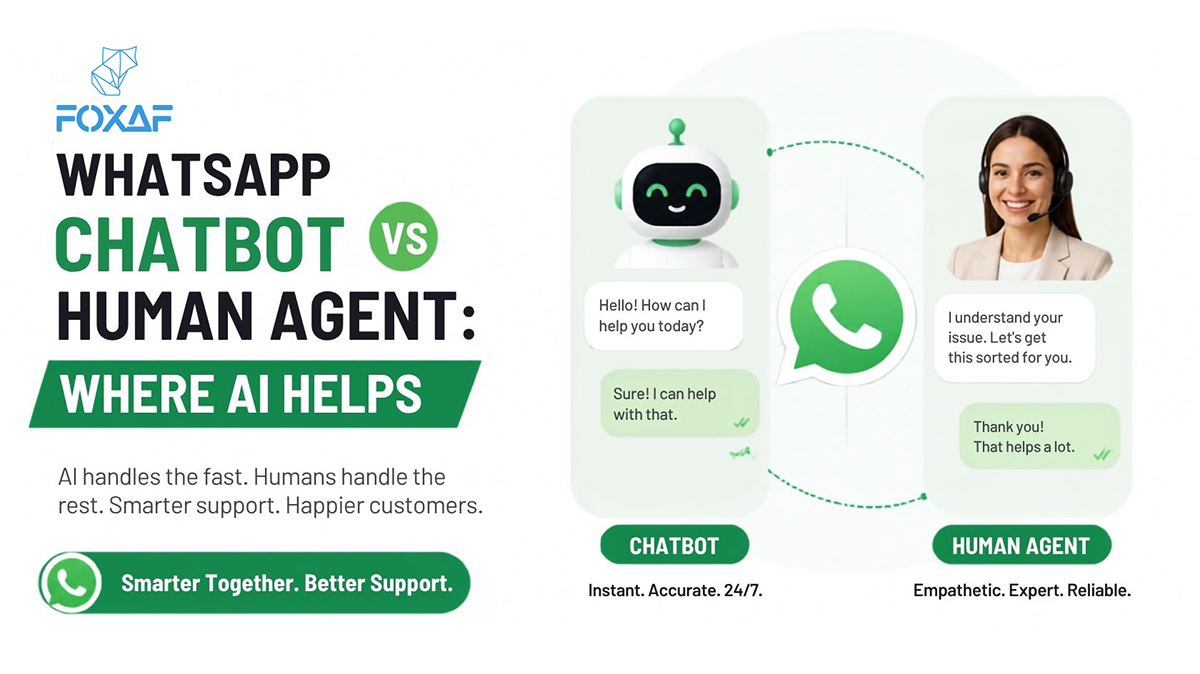
A WhatsApp chatbot handles instant, repetitive tasks — FAQs, order status, lead qualification, appointment booking — around the clock, while a human agent is better for complex complaints, negotiations, and conversations that need genuine empathy. The smartest setup is a hybrid: AI answers first, qualifies the contact, and routes to a human when the conversation demands it. That is exactly how a modern WhatsApp CRM should work.
Why does this question matter now?
Businesses on WhatsApp are scaling. When you had twenty chats a day, a two-person team could keep up. At two hundred chats, something has to give — either response times climb, leads go cold, or you hire more staff. A WhatsApp chatbot built into your CRM offers a third option: let AI handle the volume and free your people for the conversations only humans can win.
The real question is never "bot or human" — it is "which parts should each one handle?"
How do chatbots and human agents actually compare?
Here is a side-by-side comparison across the dimensions that matter most to a business running WhatsApp sales and support.
| Dimension | WhatsApp Chatbot | Human Agent |
|---|---|---|
| Response time | Instant (under 2 seconds) | Minutes to hours depending on queue |
| Availability | 24/7, including holidays | Limited to working hours or shifts |
| Cost per conversation | Near-zero marginal cost once built | Salary, training, and management overhead |
| Scalability | Handles hundreds of chats simultaneously | One agent handles 3–5 chats at a time |
| Empathy and nuance | Limited — follows scripts and patterns | Strong — reads tone, adapts naturally |
| Complex problem-solving | Weak on edge cases and multi-step issues | Strong — creative, flexible reasoning |
| Personalisation | Data-driven (name, order history, segment) | Relationship-driven (rapport, context) |
| Consistency | Every reply follows the same quality standard | Varies with mood, training, workload |
| Language handling | Handles multilingual if trained; can struggle with slang | Naturally handles local dialects and code-switching |
| Handoff ability | Can escalate to human with full context | Can escalate to specialist or manager |
Neither column wins outright. The goal is to stack them so each handles what it does best.
When should you use a WhatsApp chatbot?
Chatbots shine where speed, volume, and consistency matter more than creativity. These are the tasks where AI delivers clear ROI:
Answering FAQs instantly
"What are your prices?" "Do you deliver to Lahore?" "What's your return policy?" — these questions repeat dozens of times a day. A chatbot answers them in seconds, every time, without pulling a human away from a deal that needs attention.
Order status and tracking
An ecommerce business on WhatsApp gets a flood of "Where is my order?" messages. A chatbot integrated with your order system can pull tracking data and reply instantly — no copy-pasting from a courier dashboard. This is especially valuable for ecommerce businesses managing high COD volumes.
Lead qualification
When a new contact messages you, the chatbot can ask two or three qualifying questions — budget, timeline, location — tag the lead, and push it into the right pipeline stage. By the time a human picks up the chat, they already know if this is a hot lead or a tyre-kicker. Learn more about structuring that process in our guide to managing WhatsApp leads.
COD order confirmation
In Pakistan and similar markets, confirming cash-on-delivery orders via WhatsApp reduces returns significantly. A chatbot sends the confirmation message, waits for "YES," and updates the order — no human effort required for the routine 80%.
Appointment and demo booking
The bot shares available slots, confirms the booking, and sends a reminder. No back-and-forth scheduling emails, no missed messages at midnight.
After-hours coverage
According to industry data, roughly 40% of customer messages arrive outside business hours (Drift, 2023). Without a chatbot, those contacts wait until morning — and many never come back. A bot keeps the conversation warm until your team logs on.
Where do human agents still win?
Automation has limits, and pretending otherwise erodes trust. Here is where a trained human is irreplaceable:
Complaints and frustrated customers
An angry customer wants to feel heard, not processed. A chatbot that responds to "I've been waiting a week for my refund" with a canned message makes things worse. A human can acknowledge the frustration, apologise sincerely, and find a resolution that retains the customer.
Negotiations and custom deals
B2B pricing discussions, bulk-order negotiations, and bespoke service packages need flexibility and judgement. A bot cannot assess a prospect's long-term value and offer a tailored deal — a sales rep can.
VIP and high-value accounts
Your top 10% of customers deserve personal attention. They notice when they are talking to a bot, and they care. Assign them to named account managers and keep the relationship human.
Complex troubleshooting
When the issue has multiple steps, requires screenshots, or needs the agent to reproduce a problem — a human agent's ability to think laterally and adapt mid-conversation is essential.
Sensitive conversations
Refund disputes, contract cancellations, legal questions — situations where tone and judgement matter more than speed. Get these wrong and you lose the customer and possibly earn a public complaint.
What does a hybrid model look like?
The best-performing WhatsApp operations use a layered approach:
- AI handles first contact — greets the customer, answers the initial question, qualifies the lead, or resolves the issue if it is routine.
- AI escalates with context — when the conversation hits a trigger (sentiment shift, keyword like "speak to someone," complexity beyond the bot's scope), it routes to a human agent with the full chat history and contact record attached.
- Human resolves and closes — the agent picks up mid-conversation with full context, resolves the issue, and moves the deal forward.
- AI handles post-conversation — sends a satisfaction survey, schedules the follow-up, or triggers the next automated follow-up sequence.
This model means your team spends 80% of their time on the 20% of conversations that actually need them. The rest runs on autopilot.
How does Foxaf's AI-first approach work?
Foxaf is built as an AI-first WhatsApp CRM, which means AI is not an add-on — it is the default first responder. Here is how the pieces connect:
- AI agents on every conversation — when a message arrives, Foxaf's AI reads the context, checks the contact record, and either resolves the query or asks qualifying questions. No setup of complex decision trees; the AI understands natural language.
- Smart escalation — the system detects when a conversation needs a human (frustration signals, high-value contact flags, explicit requests) and routes it to the right team member with the full thread and CRM data attached.
- Everything stays in the pipeline — the chatbot's work, the human's work, notes, tags, and deal stages all live in one record. No switching between a bot platform and a CRM — it is one system. That is the all-in-one advantage.
- Flat pricing — AI conversations do not cost extra per message. One plan covers your inbox, pipeline, AI agents, and automations. See pricing.
The result: faster response times, lower cost per conversation, and a team that focuses on revenue-generating work instead of answering "What are your hours?" for the fiftieth time today.
What do the numbers say?
A few industry benchmarks worth knowing (these are general industry figures, not Foxaf-specific claims):
- Chatbots can handle up to 80% of routine customer queries without human intervention (IBM, 2023).
- Average chatbot response time is under 5 seconds, compared to 2–10 minutes for a staffed live chat (Tidio, 2024).
- Businesses using hybrid chat models report 35–50% reduction in support costs while maintaining customer satisfaction scores (Juniper Research, 2023).
- 69% of consumers say they prefer chatbots for quick answers but want a human option available (Salesforce State of Service, 2024).
- WhatsApp messages have an open rate above 90%, making it the highest-engagement channel for both bots and humans (Meta Business, 2023).
The takeaway: bots are fast and cheap, humans are trusted and flexible, and the combination outperforms either alone.
How to decide what your chatbot should handle
If you are setting up a WhatsApp chatbot CRM for the first time, start with this framework:
- List your top 20 incoming message types over the last month.
- Sort them: which are repetitive and have a clear answer? Those go to the bot.
- Flag the sensitive ones: complaints, refunds, negotiations. Those stay human.
- Define escalation triggers: keywords ("manager," "refund," "angry"), sentiment scores, or VIP contact tags.
- Build the bot for the repetitive list first, measure resolution rate, then expand.
- Review weekly — move conversations to the bot as you build confidence, and pull them back to humans if resolution quality drops.
This is not a one-time decision. The best teams continuously tune the boundary between bot and human based on real data.
Frequently asked questions
What is a WhatsApp chatbot CRM?
A WhatsApp chatbot CRM is a customer relationship management platform that includes a built-in AI chatbot on WhatsApp. It handles conversations, qualifies leads, and manages your pipeline — all from one system instead of separate bot and CRM tools.
Can a chatbot fully replace human agents on WhatsApp?
No. Chatbots handle routine, repetitive queries well, but complex issues, complaints, and negotiations still need human judgement. The best approach is a hybrid where the bot handles first contact and escalates to a human when needed.
How fast can a WhatsApp chatbot respond?
Typically under 5 seconds. Most well-configured bots reply in 1–2 seconds, which is significantly faster than the average human response time of several minutes during peak hours.
Will customers be annoyed by a chatbot?
Not if the bot is helpful and the handoff to a human is smooth. Research shows most customers prefer a fast bot answer for simple questions — frustration comes when a bot cannot solve their problem and there is no way to reach a person.
How much does a WhatsApp chatbot cost?
Costs vary widely. Standalone bot builders charge per conversation or per month. In Foxaf, the AI chatbot is included in the flat monthly plan with no per-message fees.
What tasks should I automate first?
Start with FAQs, order status inquiries, and lead qualification. These are high-volume, low-complexity — the sweet spot for chatbot ROI.
Can a chatbot handle Urdu and Roman Urdu?
It depends on the AI model. Modern AI-powered bots (not rule-based) can understand and respond in Urdu, Roman Urdu, and mixed-language messages. Rule-based bots with fixed keywords struggle with this.
How does the chatbot know when to hand off to a human?
Triggers include: the customer explicitly asks for a person, the query matches a "complex" category (refunds, complaints), sentiment analysis detects frustration, or the contact is tagged as VIP or high-value.
Do I need the WhatsApp Business API for a chatbot?
For basic automation you can start with a QR-code connection to your existing number. For higher volume, multiple agents, and official template messages, you will want the WhatsApp Cloud API. Both work with Foxaf.
Can I use a chatbot for WhatsApp marketing campaigns?
A chatbot handles the replies that come back from campaigns — qualifying respondents, answering questions, and routing hot leads to your sales team. The campaign itself is sent via WhatsApp broadcast, and the bot catches the inbound wave.
How do I measure if my chatbot is working?
Track: bot resolution rate (queries solved without human help), average response time, escalation rate, customer satisfaction score after bot conversations, and conversion rate for bot-qualified leads versus unqualified ones.