WhatsApp CRM with Urdu and Roman Urdu Support
Most Pakistani customers write in Roman Urdu, not Urdu script. Here is what that actually breaks in a WhatsApp CRM, the seven things to test before you buy, and an honest look at which platforms handle it.
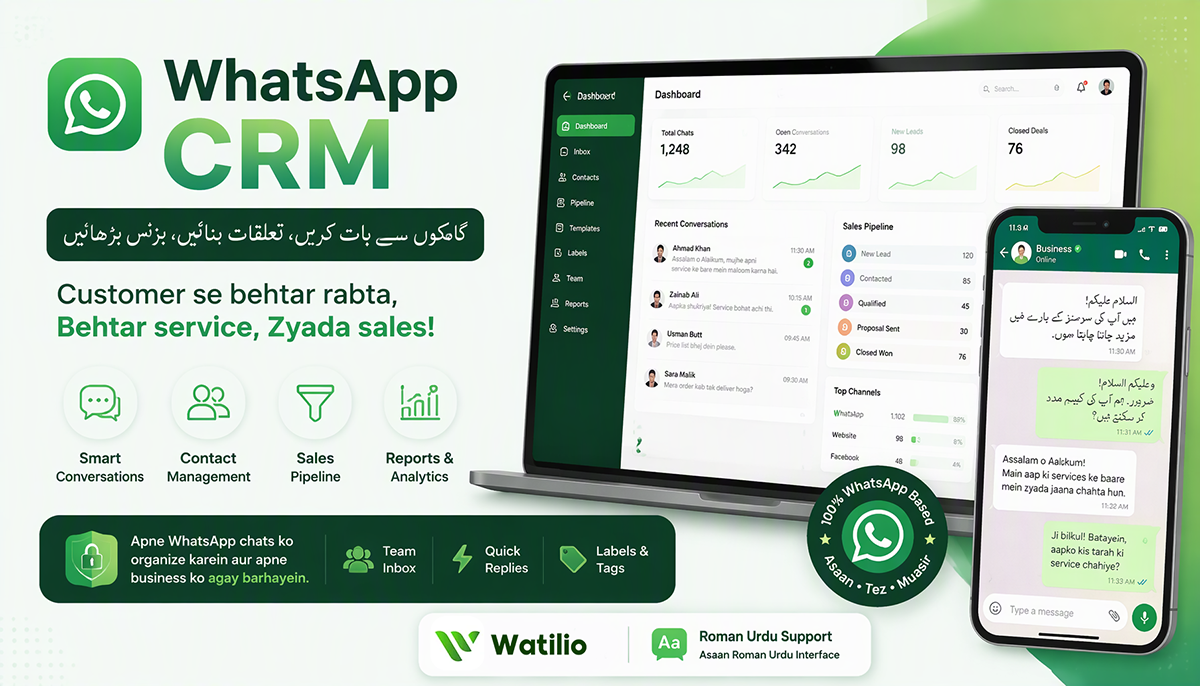
If you sell in Pakistan, most of your WhatsApp messages will arrive in Roman Urdu — Urdu written in the English alphabet, like "bhai price kya hai" — not in Urdu script. This is the single most underestimated requirement when choosing a WhatsApp CRM, because almost every platform handles Urdu script correctly and almost none of them are actually tested against Roman Urdu. The distinction matters, and it breaks different parts of your stack.
Here is what genuinely breaks, the seven things to test before you pay anyone, and an honest look at where the platforms stand.
Urdu script vs Roman Urdu: why the difference decides your shortlist
These are two different problems and vendors routinely blur them in sales calls.
Urdu script (اردو) is a right-to-left writing system. Supporting it is mostly a rendering and storage problem: does the inbox display it correctly, does it survive your database, does it break your exports, and can you submit message templates in Urdu? This is largely solved. Urdu (ur) is a supported WhatsApp message-template language, so any provider on the official WhatsApp Business Platform can submit Urdu templates.
Roman Urdu is Urdu typed in Latin characters, and it is what the overwhelming majority of Pakistani customers actually send. It has no standard spelling. "Kitne ka hai" appears as kitny ka hai, kitnay ka h, ktne ka hy, and dozens of other forms. It is frequently code-mixed with English in the same sentence: "bhai delivery charges kitne hain for Lahore?"
That lack of a standard spelling is the whole problem. It means:
- Keyword-based automation rules silently fail. A rule matching "price" never fires on qeemat or kitne ka.
- Chatbot intent matching degrades badly unless the model was trained or tuned on Roman Urdu specifically. A general multilingual model that handles Urdu script well may still perform poorly here, because Roman Urdu is under-represented in training data.
- Search inside your own inbox stops working. If your team can't find "the customer who asked about bulk pricing," your CRM history is decorative.
- Sentiment and auto-tagging misfire, which matters if you route escalations automatically.
A platform can be flawless at Urdu script and useless at Roman Urdu. Ask about them separately.
The seven things to test before you buy
Do not accept "yes, we support Urdu" as an answer. Run these in a trial account:
- Send a Roman Urdu message and search for it. Type "bhai stock hai kya" into your test inbox, then search your inbox for stock. Then search for stok. Does either find it?
- Send an Urdu-script message and check rendering end-to-end — inbox, contact record, notification email, and a CSV export. Exports are where right-to-left text usually corrupts.
- Submit one Urdu-script message template for approval. Confirm the platform actually exposes Urdu as a template language, not just "English (any text)".
- Test your automation rules against three spellings of the same word. If keyword triggers are your automation model, you need every variant, and you will keep adding them forever.
- Ask the chatbot a Roman Urdu question it was not scripted for. Something like "agar main Karachi se order karun to kitne din mein ayega?" A scripted bot will fall over; a language model may not.
- Check what language your customer gets support in, and during which hours. Pakistan business hours are PKT (GMT+5). A vendor whose support is awake in a different hemisphere is a real operational cost, separate from language.
- Mix scripts in one message. Real customers write "Salam, kya آپ کے پاس delivery available hai?" Confirm nothing truncates.
If a vendor cannot let you test all seven in a free trial, that is itself an answer.
Where the platforms actually stand
Honest summary, including where we lose.
| Capability | What to expect |
|---|---|
| Urdu-script rendering in the inbox | Broadly handled by serious platforms on the official API |
| Urdu message templates | Available to any official WhatsApp Business Platform provider |
| Roman Urdu understanding by AI | Genuinely varies — this is the real differentiator |
| Urdu-language human support | Mostly limited to Pakistan-based providers |
| PKR invoicing | Mostly limited to Pakistan-based providers |
Pakistan-based providers — WeTarseel and WAB2C among them — offer Urdu/English support as local companies, and local providers are generally the ones able to invoice in PKR. If being able to call someone who speaks Urdu during Karachi business hours is your top requirement, start there.
WhatsGrow AI publicly positions on Urdu and Roman-Urdu AI agents, and if Roman Urdu NLU is your single deciding factor they are a serious candidate. Their entry plan is $19/month, which is cheaper than ours, with a 1,000-contact ceiling.
International platforms — WATI, AiSensy, Interakt and others — will render Urdu fine and support Urdu templates, because that is a platform-level capability. Urdu-language human support and PKR invoicing are generally not on offer.
FOXAF is built by IT Vision in Pakistan, so local support is not an outsourced afterthought. To be straight with you: we do not market a Roman-Urdu natural-language model, and this page is not going to claim one. What we offer is an all-in-one WhatsApp-native CRM — inbox, pipelines, AI agents, booking, forms, sites and campaigns in one subscription — with a free plan and paid plans from $29/month including 5,000 contacts. If your deciding factor is Roman Urdu NLU specifically, weigh that honestly against the platforms above.
The workaround that works regardless of platform
Whatever you buy, this pattern reduces the Roman Urdu problem substantially and costs nothing:
Lead with structured replies instead of free text. WhatsApp supports interactive buttons and list messages. A customer tapping a "Price puchna hai" button generates a deterministic payload your automation can route perfectly — no spelling variance, no NLU required, in any language. Reserve free-text handling for the conversations that genuinely need a human.
This is also why COD confirmation flows work so reliably in Pakistan: a YES/NO button is language-independent. Design your high-volume paths around taps, not typing, and you convert your hardest language problem into a UI problem you have already solved.
So what should you actually do?
- If Urdu-language human support and PKR invoicing are non-negotiable → shortlist Pakistan-based providers first.
- If Roman Urdu AI understanding is the deciding factor → trial the platforms that specifically advertise it, and run test 5 above before paying.
- If you need a business platform that runs on WhatsApp, not just a WhatsApp inbox — pipelines, invoicing, booking, courses, campaigns — → that is a different purchase, and it is the one FOXAF is built for.
- Whatever you choose → build your highest-volume flows on buttons and lists.
Related reading: Best CRM for WhatsApp marketing in Karachi · Best WhatsApp CRM in Pakistan 2026 · WhatsApp Business API setup in Pakistan · How to choose a WhatsApp API provider in Pakistan · What is a WhatsApp CRM?
Already on another platform and want to move? See migrating to FOXAF.
Frequently asked questions
Does WhatsApp support Urdu message templates?
Yes. Urdu (ur) is a supported message-template language on the WhatsApp Business Platform. You select the language when you submit each template for approval, and templates are approved per language. Any provider working on the official API can submit Urdu templates.
What is the difference between Urdu support and Roman Urdu support in a CRM?
Urdu support usually means the platform correctly displays and stores right-to-left Urdu script and can send Urdu templates — largely a solved rendering problem. Roman Urdu support means the platform can understand Urdu written in the English alphabet, which has no standard spelling. The second is much harder and varies enormously between platforms. A CRM can be perfect at the first and poor at the second, so ask about them separately.
Can a WhatsApp chatbot understand Roman Urdu?
Some can. Because Roman Urdu has no fixed spelling and is often mixed with English in the same sentence, keyword-based bots perform poorly — a rule matching "price" will not fire on "qeemat" or "kitne ka hai". Platforms using language models tuned for Roman Urdu do considerably better. Test it before you buy by asking an unscripted Roman Urdu question in a trial account.
Which WhatsApp CRMs offer support in Urdu?
Pakistan-based providers are generally the ones offering Urdu-language human support. WeTarseel and WAB2C offer Urdu/English support, and FOXAF is built by IT Vision in Pakistan and provides local support. International platforms such as WATI and AiSensy will handle Urdu text correctly but typically do not offer Urdu-language support staff or PKR invoicing.
How much does a WhatsApp CRM with Urdu support cost in Pakistan?
It varies by provider and by whether you need a WhatsApp inbox or a full CRM. FOXAF has a free plan, with paid plans starting at $29/month including 5,000 contacts. Some Pakistan-focused competitors start lower — WhatsGrow AI's entry plan is $19/month with a 1,000-contact ceiling. Note that WhatsApp conversation fees are charged by Meta directly and are separate from any platform's subscription, whichever provider you choose.
Do I need the WhatsApp Business API to send Urdu messages?
No — the free WhatsApp Business app sends Urdu text fine. You need the API when you need multiple team members on one number, broadcasts beyond 256 contacts, automation, COD confirmation flows, or CRM pipelines. Language is not what determines whether you need the API; scale and automation are.
Frequently asked questions
Does WhatsApp support Urdu message templates?
Yes. Urdu (ur) is a supported message-template language on the WhatsApp Business Platform. You select the language when you submit each template for approval, and templates are approved per language. Any provider working on the official API can submit Urdu templates.
What is the difference between Urdu support and Roman Urdu support in a CRM?
Urdu support usually means the platform correctly displays and stores right-to-left Urdu script and can send Urdu templates, which is largely a solved rendering problem. Roman Urdu support means the platform can understand Urdu written in the English alphabet, which has no standard spelling. The second is much harder and varies enormously between platforms, so ask about them separately.
Can a WhatsApp chatbot understand Roman Urdu?
Some can. Because Roman Urdu has no fixed spelling and is often mixed with English in the same sentence, keyword-based bots perform poorly: a rule matching 'price' will not fire on 'qeemat' or 'kitne ka hai'. Platforms using language models tuned for Roman Urdu do considerably better. Test it before you buy by asking an unscripted Roman Urdu question in a trial account.
Which WhatsApp CRMs offer support in Urdu?
Pakistan-based providers are generally the ones offering Urdu-language human support. WeTarseel and WAB2C offer Urdu/English support, and FOXAF is built by IT Vision in Pakistan and provides local support. International platforms such as WATI and AiSensy will handle Urdu text correctly but typically do not offer Urdu-language support staff or PKR invoicing.
How much does a WhatsApp CRM with Urdu support cost in Pakistan?
It varies by provider and by whether you need a WhatsApp inbox or a full CRM. FOXAF has a free plan, with paid plans starting at $29/month including 5,000 contacts. Some Pakistan-focused competitors start lower: WhatsGrow AI's entry plan is $19/month with a 1,000-contact ceiling. WhatsApp conversation fees are charged by Meta directly and are separate from any platform's subscription.
Do I need the WhatsApp Business API to send Urdu messages?
No. The free WhatsApp Business app sends Urdu text fine. You need the API when you need multiple team members on one number, broadcasts beyond 256 contacts, automation, COD confirmation flows, or CRM pipelines. Language is not what determines whether you need the API; scale and automation are.