How to Handle Hundreds of WhatsApp Inquiries a Day (Pakistan, 2026)
A practical playbook for Pakistani businesses drowning in WhatsApp inquiries: triage, routing, AI first-replies and the numbers that decide when one number stops being enough.
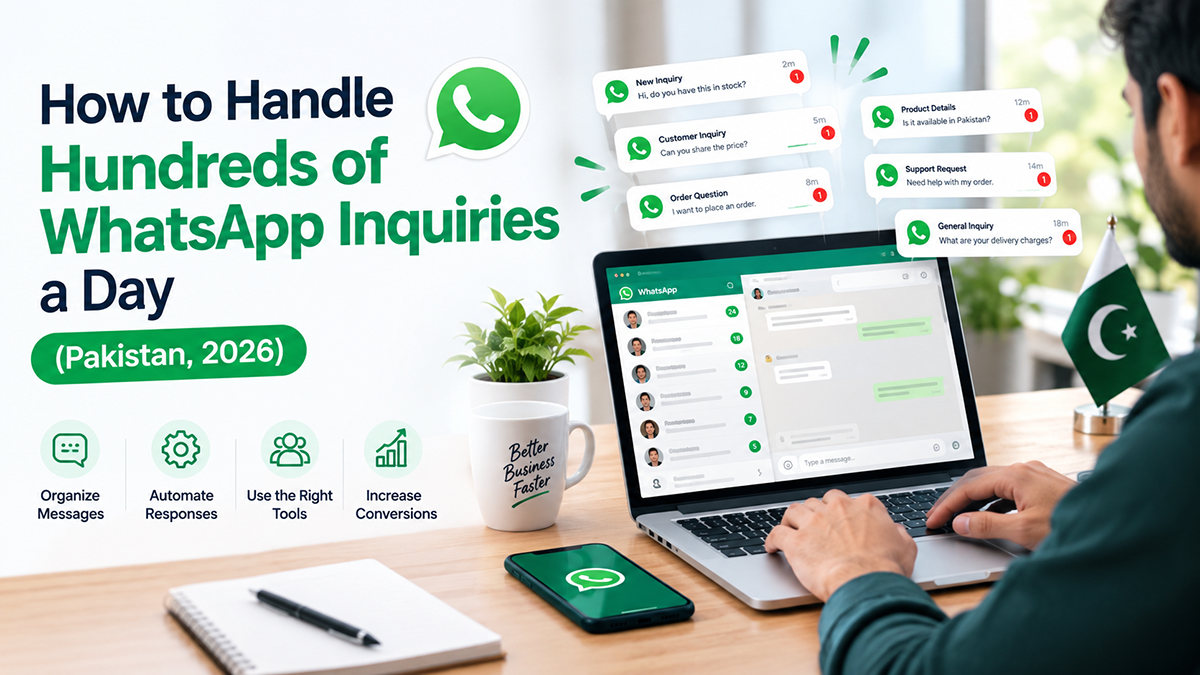
You ran one good campaign. Now your phone will not stop buzzing.
This is the most common growth problem in Pakistani commerce right now, and it is a strange one, because it looks exactly like success. Inquiries are up. Revenue is not — or not by as much as it should be. Somewhere between the first "price kya hai?" and the confirmed order, a large share of those messages quietly die.
This article is about that gap: why it opens, how to measure it, and what to do about it in a market where WhatsApp is the storefront, the call centre and the checkout counter at once.
Why high inquiry volume breaks WhatsApp before it breaks anything else
In most of the world, a spike in demand hits a form, a helpdesk or a phone queue — systems built with the assumption that more than one person will handle the work.
In Pakistan it hits WhatsApp, which was built on the opposite assumption. One number, one device, one person. That single design decision is the root of nearly every symptom below:
- Only one human can work the inbox at a time. The phone is on someone's desk. When they are at lunch, the business is closed.
- There is no queue. WhatsApp orders chats by most-recent-message, not by who has waited longest or who is most likely to buy. The customer who messaged four hours ago sinks.
- There is no assignment. Two team members answer the same customer; a third is answered by nobody.
- There is no record. When a buyer returns after a week, whoever picks up the phone starts from zero.
- The archive is the device. Staff turnover takes the conversation history with it.
None of that matters at twenty messages a day. All of it matters at three hundred.
The number that actually decides it
Forget "how many messages do we get". The number that predicts whether you are losing money is first-response time, and specifically the share of inquiries that wait longer than a few minutes.
WhatsApp buyers behave like walk-in customers, not like email senders. They are usually messaging two or three sellers at once, from the same ad, in the same minute. In that situation, a reply is not just a reply — it is a claim on the order. The seller who answers first is frequently the seller who is still in the conversation an hour later.
So the honest diagnostic is not "are we replying?" It is: of the inquiries that arrived yesterday, how many got a human or automated answer within five minutes? Most businesses who run that count for the first time are unpleasantly surprised.
The four stages of WhatsApp volume, and what each one needs
Businesses tend to pass through the same four stages. The mistake is buying stage-four tooling at stage one, or — far more commonly — running stage-one tooling deep into stage three.
| Stage | Roughly | What it feels like | What you actually need |
|---|---|---|---|
| 1. Personal | under ~30 inquiries/day | One person, one phone, it works | Nothing. Do not buy software. |
| 2. Strained | ~30–100/day | Replies slipping to hours; two staff sharing one phone | A shared inbox so more than one person can work the same number |
| 3. Breaking | ~100–400/day | Missed orders you only discover later; no idea who answered what | Assignment + routing + saved replies + a contact record that survives staff changes |
| 4. Industrial | 400+/day, or multiple numbers | Volume is a staffing problem, not an app problem | Automated first-reply, qualification before a human is involved, and WhatsApp Business API |
⚠️ Be honest about which row you are in. The single most expensive error here is a stage-two business buying a stage-four automation stack, automating a process it has not yet defined, and producing faster wrong answers.
Step 1 — Stop losing messages before you try to automate them
The instinct at high volume is to reach for a chatbot. That is usually the third fix, not the first.
Get the inbox off the device. As long as the conversation lives on one phone, every other improvement is capped by that phone's availability. A shared team inbox means several people work the same WhatsApp number at once, each message can be assigned to a named owner, and the history stays with the business rather than the handset. FOXAF's shared inbox funnels WhatsApp, email, SMS and website live chat into a single queue; most credible competitors offer some version of the same thing, and you should compare them on how assignment and routing actually work rather than on feature-list length.
Then make the queue visible. You cannot manage what you cannot see. At minimum you want to be able to answer, at a glance: how many conversations are unanswered right now, and what is the oldest one.
Then kill the duplicate-reply problem. Assignment and internal notes sound like small features. At 200 inquiries a day they are the difference between a team and a crowd.
If none of this vocabulary is familiar yet, the plain-language version is here: what a WhatsApp CRM actually is.
Step 2 — Triage, because not every inquiry is worth the same
At high volume, treating every message identically is itself the problem. A serious buyer asking about bulk pricing and a browser asking "price?" on a PKR 800 item should not consume the same minutes.
A workable triage for most Pakistani sellers:
- Ready to buy — has named a product, a quantity, or an address. Answer first, always.
- Qualifying — asking about price, delivery time, sizes, warranty. Answer with a saved reply and a question that moves them forward.
- Support — existing customer, order status, returns. Route away from the sales queue entirely.
- Noise — wrong number, resellers, "hi" with no follow-up. Do not spend a human on these.
Most teams find that categories 2 and 4 are the bulk of the volume and almost none of the revenue. That is exactly where automation earns its place — which is the next step, and not before.
For the mechanics of moving people through those stages, how to manage WhatsApp leads covers the pipeline side in more detail.
Step 3 — Automate the first reply, not the whole conversation
Here is where high-volume WhatsApp goes wrong most often. A business automates the entire sales conversation, the bot mishandles anything unusual, and buyers leave with a worse impression than if nobody had replied.
The reliable pattern is narrower: automate the first reply and the qualification, then hand to a human. Done properly this does three things at once — it claims the conversation within seconds, it collects the information a human would have had to ask for anyway, and it filters the noise.
FOXAF's AI agents are built for exactly this shape: an agent answers the first reply around the clock, qualifies against guardrails you set, and hands off to the right teammate with the conversation context attached. Claude and GPT agents are included on every paid tier.
⚠️ Two honest cautions, because this is where money gets wasted:
- An AI first-reply is not a substitute for staffing. It buys you the first five minutes. If nobody picks up the handoff for six hours, you have automated the appearance of responsiveness.
- Test it in the language your customers actually use. A great deal of Pakistani WhatsApp commerce happens in Roman Urdu, and AI handling of Roman Urdu varies sharply between vendors. Do not take any vendor's word for this, including ours — run twenty of your own real past conversations through a trial and read the replies yourself before you commit. We cover the language question in more depth in Urdu and Roman Urdu WhatsApp support.
If you are weighing how much to hand to a bot at all, WhatsApp chatbot vs human agent works through the trade-off.
Step 4 — Decide whether you have outgrown WhatsApp Business App
There is a hard ceiling, and a lot of businesses hit it without realising what it is.
The free WhatsApp Business app is built around a single device and a single operator. Once you genuinely need several people answering one number simultaneously, automated replies at scale, and message delivery you can rely on, you are looking at WhatsApp Business API — which is not an app you install but an access route you get through a provider.
That transition is a real decision with real costs, and it is covered properly in WhatsApp Business API in Pakistan and Business App vs API.
⚠️ One thing to budget for that catches people out: with the API, Meta charges for conversations separately from whatever your software vendor charges. Ask any vendor plainly whether they add a markup on top of Meta's conversation rates. Some do. FOXAF does not, and you should make every shortlisted vendor answer the same question in writing.
Step 5 — Follow up, because most of the revenue is in the messages nobody sent
At high volume, the follow-up is the first thing to be dropped — and it is usually where the largest recoverable revenue sits. The buyer who asked about delivery and went quiet is not a lost cause; they are an unfinished conversation.
Automated, well-timed follow-up sequences are genuinely low-risk compared to full conversational automation, because the failure mode is mild (a slightly unnecessary message) rather than severe (a mangled sales conversation). Automating WhatsApp follow-ups covers the timing and the templates.
⚠️ Stay inside the rules. Broadcast and template messaging are governed by Meta's policies and by WhatsApp's quality rating. Businesses that blast unsegmented lists get their numbers rate-limited or blocked, and recovering a damaged quality rating takes far longer than earning it did. Follow-ups should be to people who messaged you, about the thing they messaged you about.
What to look for when comparing tools
At high volume, the feature lists all start to look the same. These are the questions that actually separate the tools:
| Question to ask | Why it matters at volume |
|---|---|
| Can several agents work one number at the same time? | This is the stage-two ceiling. If not, nothing else matters. |
| How does assignment work — manual, rules, or round-robin? | Manual assignment stops scaling at roughly one supervisor's attention. |
| Is there a markup on Meta's conversation charges? | At high volume this can exceed the software subscription. |
| Does the contact history survive a staff change? | The single most common hidden cost of device-based WhatsApp. |
| Does pricing scale with contacts or messages? | Per-contact pricing punishes exactly the growth you are trying to achieve. |
| Can the AI handle the language your customers write in? | Test with your own conversations, not the vendor's demo. |
| What happens when the AI cannot resolve something? | A bot with no clean handoff is worse than no bot. |
On the fifth row, FOXAF is flat-priced — plans start at $29/mo and the plan does not change as your contact count grows, with no markup on WhatsApp message costs. Current limits and tiers are on the pricing page; we deliberately do not restate the higher tiers here, so that this article cannot go stale against it.
⚠️ And the honest framing: several vendors solve the shared-inbox problem competently. If your deciding factor is Roman-Urdu conversational AI specifically, or PKR-denominated billing, there are Pakistan-based providers who market those directly and you should shortlist them alongside us. We think we win on being an all-in-one CRM rather than a WhatsApp add-on — but that is a different argument, and it is not the right one for every buyer.
For a broader view of the market, see the best WhatsApp CRMs for Pakistan.
A 30-day plan that does not require buying anything on day one
Week 1 — measure. Count yesterday's inquiries and how many were answered within five minutes. Write the number down. This is your baseline and you will want it later.
Week 2 — get off the single device. Move to a shared inbox so more than one person can work the number. Do not automate anything yet.
Week 3 — triage and templates. Define your four categories. Write saved replies for the ten questions you answer most. Measure first-response time again.
Week 4 — automate the first reply only. Put an AI agent on the first response and qualification, with a clean handoff. Test it in your customers' real language, with your own past conversations.
Only after that is stable should you look at full conversational automation or a second number. Most businesses find that steps one to three recover more revenue than step four ever does.
Frequently asked questions
How many WhatsApp inquiries a day can one person realistically handle? For genuine sales conversations rather than one-line answers, most operators manage somewhere in the region of 50–80 a day before quality drops noticeably. It varies enormously with ticket size and how much back-and-forth each sale needs — which is why you should measure your own first-response time rather than trusting any general figure, including this one.
Do I need WhatsApp Business API to handle high volume? Not always. If your ceiling is "only one person can use the phone", a shared inbox on top of a WhatsApp QR connection may solve it. You need the API when you require several simultaneous agents, automation at scale, and reliable template messaging. It is a real cost step, so make sure the simpler fix genuinely does not work first.
Will an AI agent annoy my customers? It can, if you automate the whole conversation. The pattern that works is narrow: the AI takes the first reply and the qualifying questions, then hands to a human with context. Customers generally react well to an instant, accurate first response and badly to a bot that will not let them reach a person.
Does FOXAF's AI handle Roman Urdu? We do not market a Roman-Urdu natural-language model, and this page is not going to claim one. If Roman-Urdu conversational AI is your deciding requirement, test it yourself on a trial with your own past conversations, and shortlist Pakistan-based providers who market that capability directly alongside us.
What does FOXAF cost? Plans start at $29/mo, flat-priced, with no per-contact fees and no markup on WhatsApp message costs. Current tiers and limits are on the pricing page.
Will automating follow-ups get my number blocked? It can, if you broadcast to people who never messaged you or send unsegmented bulk campaigns. Follow-ups to people who contacted you, about the thing they contacted you about, are low-risk. Watch your quality rating in WhatsApp Manager — recovering a damaged rating takes considerably longer than protecting it.
What is the first thing I should fix? Measure the percentage of inquiries answered within five minutes, then get the inbox off a single device. Almost every other improvement is capped by those two things.
Written by the FOXAF team. FOXAF is a WhatsApp-native, AI-first all-in-one CRM. Questions: contact us.
Frequently asked questions
How many WhatsApp inquiries a day can one person realistically handle?
For genuine sales conversations rather than one-line answers, most operators manage somewhere in the region of 50–80 a day before quality drops noticeably. It varies enormously with ticket size and how much back-and-forth each sale needs — which is why you should measure your own first-response time rather than trusting any general figure, including this one.
Do I need WhatsApp Business API to handle high volume?
Not always. If your ceiling is "only one person can use the phone", a shared inbox on top of a WhatsApp QR connection may solve it. You need the API when you require several simultaneous agents, automation at scale, and reliable template messaging. It is a real cost step, so make sure the simpler fix genuinely does not work first.
Will an AI agent annoy my customers?
It can, if you automate the whole conversation. The pattern that works is narrow: the AI takes the first reply and the qualifying questions, then hands to a human with context. Customers generally react well to an instant, accurate first response and badly to a bot that will not let them reach a person.
Does FOXAF's AI handle Roman Urdu?
We do not market a Roman-Urdu natural-language model, and this page is not going to claim one. If Roman-Urdu conversational AI is your deciding requirement, test it yourself on a trial with your own past conversations, and shortlist Pakistan-based providers who market that capability directly alongside us.
What does FOXAF cost?
Plans start at $29/mo, flat-priced, with no per-contact fees and no markup on WhatsApp message costs. Current tiers and limits are listed on the FOXAF pricing page.
Will automating follow-ups get my WhatsApp number blocked?
It can, if you broadcast to people who never messaged you or send unsegmented bulk campaigns. Follow-ups to people who contacted you, about the thing they contacted you about, are low-risk. Monitor your quality rating in WhatsApp Manager, because recovering a damaged rating takes considerably longer than protecting it.
What is the first thing I should fix when WhatsApp inquiries get overwhelming?
Measure the percentage of inquiries answered within five minutes, then get the inbox off a single device so more than one person can work the number. Almost every other improvement is capped by those two things.